Available 24/7
Home / Alabama
Alabama holds a dog’s owner liable for an unprovoked bite or injury to anyone lawfully on the owner’s property, or chased off it by the dog, without proof the dog had bitten before. Away from the owner’s property, the rule flips: you must prove the owner or keeper knew, or had reason to know, that the dog was dangerous. And Alabama still applies contributory negligence, so the dog owner’s insurer will look hard at anything you did.
This page covers both routes to compensation, the restraint laws including the new tethering law, who counts as an owner or keeper, the defenses, the contributory negligence rule, a child’s case, landlord liability, every filing deadline including the short notice periods for cities and counties, damages and the punitive damages caps, Emily’s Law on dangerous dogs, reporting and rabies quarantine, settlement value, and insurance.
Dog Bite Laws handles dog attack cases. Talk to us for free, and pay no fee unless we recover money for you.
Alabama has a dog bite statute, but it covers limited ground. Section 3-6-1 of the Code of Alabama says that if a dog, “without provocation,” bites or injures a person who is at a place where he or she has a legal right to be, the owner is liable in damages. Then comes the limit. That liability arises only when the person is on property owned or controlled by the dog’s owner, or was on that property just before and was pursued from it by the dog. The wording dates from 1953.
Inside that boundary, you do not have to prove the dog had a history. The Supreme Court of Alabama has described the statute as shifting the burden of proof of scienter, the legal word for the owner’s knowledge, onto the owner. Under section 3-6-3, the owner may plead and prove that he had no knowledge of any circumstances indicating the dog was vicious, dangerous, or mischievous. If he succeeds, he is liable only for the actual expenses you incurred because of the bite. So what the owner knew about the dog still decides how much the statutory claim is worth, even though it does not decide whether there is one.
Outside that boundary, Alabama follows the older common law, often called the one bite rule. In Humphries v. Rice, decided in 1992, the Supreme Court of Alabama repeated that the crucial issue is whether the owner knows, or had reason to know, of the animal’s dangerous propensities, and that the plaintiff must prove it. That knowledge can be inferred from circumstances.
The statute does not replace that common law claim. Section 3-6-4 says nothing in the chapter diminishes any right that already existed for dog bites, and in 2002 the Supreme Court of Alabama read it as preserving the common law right of action. A third route sits in the general animal chapter: section 3-1-3 makes the owner or keeper of a vicious or dangerous animal liable when careless management, or letting it go at liberty, injures a person who was without fault.
Under section 3-6-1, read straight from the statute, you prove five things:
The second point matters more than it looks. In McCaster v. Jackson, a pharmacy delivery driver was never bitten. The owner opened the front door, her dog ran out at him, and he fell running for his truck, injuring both knees and a shoulder. The Supreme Court of Alabama reversed the summary judgment against him on his statutory claim because there was testimony that he did not provoke the dog, had a right to be there, and was on or being chased from property the owner controlled.
The fifth point is the one that ends cases. In Williams v. Hill, a golden retriever ran into a public road and collided with a motorcycle. The riders had never entered the owner’s property, so the court called the statute clearly inapplicable.
A common law claim asks for something different: that the defendant owned or kept the dog, knew or had reason to know of its dangerous propensities, and that the injury followed. Proof that a dog barked at people or looked large and mean has not been enough. In one 1987 lawsuit decided under the lenient scintilla of evidence standard then in effect, a dispute over an earlier escape in which the dog jumped on a small child, reported to police, was enough to defeat summary judgment. Every earlier complaint and near miss is worth finding.
Alabama’s general restraint statute dates from 1915. Section 3-1-5 requires every person owning or having charge of a dog to confine it to the premises where it is regularly kept, unless the dog is accompanying that person elsewhere. The fine runs from $2 to $50. More important is the fine print: the section does not apply inside any city or town that requires dogs to wear a license tag, and it does not apply in a county until the county commission adopts it. So whether this statewide rule reached the place you were bitten depends on local action, and a city’s own animal control ordinance may be the rule that matters.
Alabama added a statewide tethering law in 2026. Act 2026-427, reported in the news as Beau’s Law, created chapter 3-6B of the Code. Under section 3-6B-2, a dog may be tethered to a stationary object only by a trolley system, and the tether must not allow the dog to leave the property of the owner or person responsible for it. A dog kept in an enclosure must be in one that is secure, fully fenced, and does not allow it to leave the property. The same section requires that a tethered or enclosed dog have continuous access to food, water, and shelter. The rule does not order every dog to be confined, but for a dog kept on a tether or in an enclosure, the setup must not let the dog leave the property.
How these rules help your claim depends on where you were bitten. On the owner’s property, section 3-6-1 already supplies liability, so a leash or tether violation adds proof of how the dog reached you rather than liability itself. Off the property, where you must prove the owner was careless and knew the risk, a broken chain, an open gate, a dog with a habit of roaming, or a citation in the animal control file becomes part of that proof. Whether a violation counts as negligence on its own is a question for your lawyer, and it turns on the exact rule in force where the bite happened.
The answer depends on which claim you bring. Section 3-6-1 reaches the owner and nobody else. In Humphries, a pit bull knocked down a gas delivery worker at a mobile home on land owned by the dog owner’s parents. The jury found against the owner’s mother too, and the Supreme Court of Alabama reversed. The statute does not say owner or keeper, the court said, and the legislature could easily have added those words. It refused to extend the statute to anyone other than the owner of the dog.
The common law claim reaches both owners and keepers. But being a keeper takes more than living nearby. The mother in Humphries was not a keeper because there was no evidence she undertook any responsibilities with regard to the dog: her son had his own residence, paid his own bills, and fed and maintained the dog himself. The court also noted there was no evidence she cared for the dog, which was kept on a cable near her son’s mobile home rather than roaming her property.
Alabama’s dangerous dog and rabies chapters define owner more broadly. Both include anyone who keeps or harbors a dog, has it in his or her care, acts as its custodian, or permits it to remain on or about premises he or she occupies. Those definitions control the chapters they appear in, not the civil statute, but they are a useful checklist of the people to identify early. Each may carry a separate insurance policy. For more, read what determines ownership of a dog.
Section 3-6-1 carries its own two defenses. The owner is not liable under the statute if the dog acted with provocation, or if you were not at a place where you had a legal right to be. The statute does not define provocation. Expect the owner’s insurer to stretch the word, and do not accept its version of what you did. Our guide to dog bite provocation explains how the argument usually goes.
On the legal right to be there, the legislature wrote a list. Section 3-6-2 says a person is lawfully on the owner’s private property when performing a duty imposed by state or federal law, including postal duties, when reading meters, delivering milk, or repairing a public utility or service, or when there on the express or implied invitation of the owner or lessee. Both Humphries and McCaster involved delivery workers, one making a requested gas delivery and one making a regular pharmacy delivery. A guest invited over by the owner or a tenant fits the invitation clause.
A trespasser will have trouble with the statute, which applies only to a person at a place where he or she has a legal right to be. The dangerous dog law points the same way: under section 3-6A-4(j), a dog is presumed not dangerous if the victim was trespassing.
Your own conduct can also be raised against a negligence claim, as the next section explains.
Alabama still uses contributory negligence. In Alabama, a plaintiff’s own negligence that contributed to the injury can bar a negligence claim completely. The Supreme Court of Alabama considered abandoning the rule and, in Williams v. Delta International Machinery Corp. in 1993, refused, noting it had been the law in Alabama for approximately 162 years. The trial judge in that case had charged the jury on what he called plain Alabama contributory negligence as a complete defense.
The rule has limits that matter in a dog case:
The vicious animal statute, section 3-1-3, builds the rule in: it protects a person injured “without fault on his part.”
A question from an adjuster about whether you reached toward the dog or stepped into the yard is often the start of this defense. Answer it only after talking to a lawyer.
Alabama gives children a longer deadline. The age of majority under section 26-1-1 is 19, not 18. Under section 6-2-8, a person under 19 when a claim accrues has three years after turning 19, or the normal limitation period if that is shorter. Because the normal period for a dog bite is two years, a child generally has until two years after the nineteenth birthday, which is the twenty first birthday. No disability can stretch the period past 20 years from the bite.
The parent’s own claim is different. Section 6-5-390 gives a father and mother living together an equal right to sue for an injury to their minor child, and gives the parent with legal custody the exclusive right when they are not. Do not assume that claim rides on the child’s longer clock: section 6-2-8 pauses the deadline for the person who is under 19.
The fault rule bends for children as well. In Jefferson v. Fleming in 1995, the Supreme Court of Alabama quoted Alabama’s pattern jury instruction that a child between 7 and 14 is presumed incapable of contributory negligence, a presumption that evidence can rebut, and held that adult traffic standards of care did not apply to a seven year old riding a bicycle. A child over fourteen can be found contributorily negligent.
One Alabama case shows how these claims look. In King v. Breen, a two and a half year old wandered into a neighbor’s yard and hugged a chained dog he mistook for one he had once owned. The dog bit him on the face and shoulder and left permanent scars. The dog had earlier escaped a fence and jumped on another small child. Under the lenient scintilla of evidence standard that applied to that 1987 lawsuit, the Supreme Court of Alabama held that the dispute over that incident meant the knowledge claim should not have been thrown out before trial. If an adjuster is blaming your child, read whether a child can provoke a dog, then call a lawyer.
A landlord is not the owner of a tenant’s dog, so section 3-6-1 does not reach a landlord. The route is ordinary negligence, and Alabama has a clear rule for one setting. In Gentle v. Pine Valley Apartments, decided in 1994, a ten year old was bitten on the lip by a tenant’s chow mix in an apartment courtyard and needed reconstructive surgery. The Supreme Court of Alabama held that a tenant’s vicious dog in areas shared by other tenants is a dangerous condition, and that a landlord must exercise reasonable care to prevent injuries from it.
The catch is notice. The court said notice to the property owner, direct or imputed, of the dangerous condition is the essential requirement of liability. For the first bite, the mother’s only proof that management knew about the dog’s aggression was what other tenants had told her, which was hearsay, and that claim failed. But she reported the bite to the resident manager right away, management did nothing, and five months later the same dog trampled the boy and scratched his back in the common area. That second claim went back for a jury.
Three practical points follow:
Owning the land is not enough by itself either: in Humphries, the parents owned the property, and the mother was still neither owner nor keeper.
The basic rule is two years. Section 6-2-38(l) requires actions for any injury to the person not arising from contract to be brought within two years. The shorter government deadlines are the ones that catch people.
A claim against local government is also limited in amount. Under section 11-47-190 a city or town is liable only for the neglect, carelessness, or unskillfulness of its own agents or employees, and recovery is capped at $100,000 per injured person and $300,000 per occurrence. Section 11-93-2 sets similar limits for counties and other governmental entities. A dog claim against local government might involve a police dog, an animal shelter, or animal control.
Treat each of these as an outside limit. Our guide to the dog bite statute of limitations explains how these clocks fit together.
Alabama law gives a working vocabulary for how serious a dog injury is. Emily’s Law borrows the criminal code’s definitions. A physical injury is impairment of physical condition or substantial pain. A serious physical injury is one that creates a substantial risk of death, or causes serious and protracted disfigurement, protracted impairment of health, or protracted loss or impairment of the function of any bodily organ, under section 13A-1-2. Emily’s Law also defines bitten as seized with the teeth so that the skin is gripped, wounded, or pierced, resulting in physical injury.
Compensatory damages in an Alabama personal injury claim include medical and hospital expenses, which section 12-21-45 describes as legally recoverable for personal injury, and Alabama’s punitive damages statute recognizes claims for mental anguish and emotional distress. Your lawyer can tell you which other losses, such as lost wages and scarring, belong in your claim. Two Alabama rules shape the number:
Punitive damages are available in Alabama only on clear and convincing evidence that the defendant consciously or deliberately engaged in oppression, fraud, wantonness, or malice, under section 6-11-20. In a physical injury case, section 6-11-21 caps them at three times compensatory damages or $1,500,000, whichever is greater, before the statute’s inflation adjustments, which apply every three years. The jury is not told about the cap, and the cap does not apply to wrongful death or to intentional infliction of physical injury.
Government defendants are different. No punitive damages may be awarded against the state, a county, or a city, and the $100,000 per person limit described in the deadlines section applies. For a broader overview, see dog bite compensation and our guide to dog bite settlement amounts.
Alabama’s dangerous dog statute is Emily’s Law, chapter 3-6A of the Code, enacted by Act 2018-182. A dangerous dog is one, regardless of breed, that has bitten, attacked, or caused physical injury, serious physical injury, or death to a person without justification. Police dogs used for legitimate law enforcement purposes are excluded.
The process starts with a sworn statement. Under section 3-6A-4, a person who claims a dog is dangerous makes a sworn statement before a city magistrate or sheriff naming the owner, if known, where the dog is kept, and why it is dangerous. An animal control officer investigates, or a law enforcement officer where the dog caused serious physical injury or death. If the claim is founded, the dog is impounded at the owner’s expense and a county or municipal attorney or prosecutor may ask the court to declare it dangerous.
The court decides by reasonable satisfaction whether the dog bit, attacked, or injured a person without justification. If it caused serious physical injury or death, the court must order it euthanized. Otherwise the court decides whether the dog has a propensity to cause future serious physical injury or death. If it does, the court may order euthanasia or return the dog to an owner who microchips, vaccinates, and spays or neuters it, pays all costs and a $100 annual registration fee, builds a locked enclosure, and obtains a surety bond of at least $100,000 that covers dog bites. A finding that a dog is dangerous may be appealed to circuit court.
The criminal side is serious. Under section 3-6A-5, an owner whose declared dangerous dog causes serious physical injury or death commits a Class B felony. An owner whose dog was never declared commits a Class C felony if the dog causes serious physical injury or death and the owner had prior knowledge of its dangerous propensities yet showed reckless disregard of them. A convicted owner must pay the victim’s medical expenses.
A dangerous dog case does not award you damages, and section 3-6A-7 says the chapter does not take away any civil remedy. Watch one wrinkle. A dog is presumed not dangerous under Emily’s Law if it was on its owner’s property when the event happened, yet that is exactly where section 3-6-1 makes the owner liable. Because the two statutes are separate and Emily’s Law preserves civil remedies, a failed dangerous dog petition does not by itself end a section 3-6-1 claim.
In Alabama the duty to report a bite is unusually broad. Under section 3-7A-9, it is unlawful for any person who knows a human being has been bitten or exposed by a dog to fail to notify the county rabies officer or the health officer. The Alabama Department of Public Health says any bite should be checked by a physician and reported to the county health department, and its rabies page links the Rabies Exposure Report form for that purpose. Here is what happens after a dog bite is reported.
Once the officer is told, the dog must be quarantined under the direct supervision of a licensed veterinarian for rabies observation. The quarantine period is 10 days from the exposure, unless the health officer directs otherwise. A vaccinated dog may be allowed to serve its quarantine at the owner’s home if the health officer authorizes it. The owner pays the costs. The owner may not sell, give away, move, or otherwise dispose of the dog until it is released, and the veterinarian must report the results to your doctor and to the health officer.
Why ten days? The department explains that a dog shedding rabies virus in its saliva will show signs of rabies or die within that window, so a dog that stays entirely well for 10 days was not carrying the virus in its saliva when it bit. Whether you need treatment is still your doctor’s call.
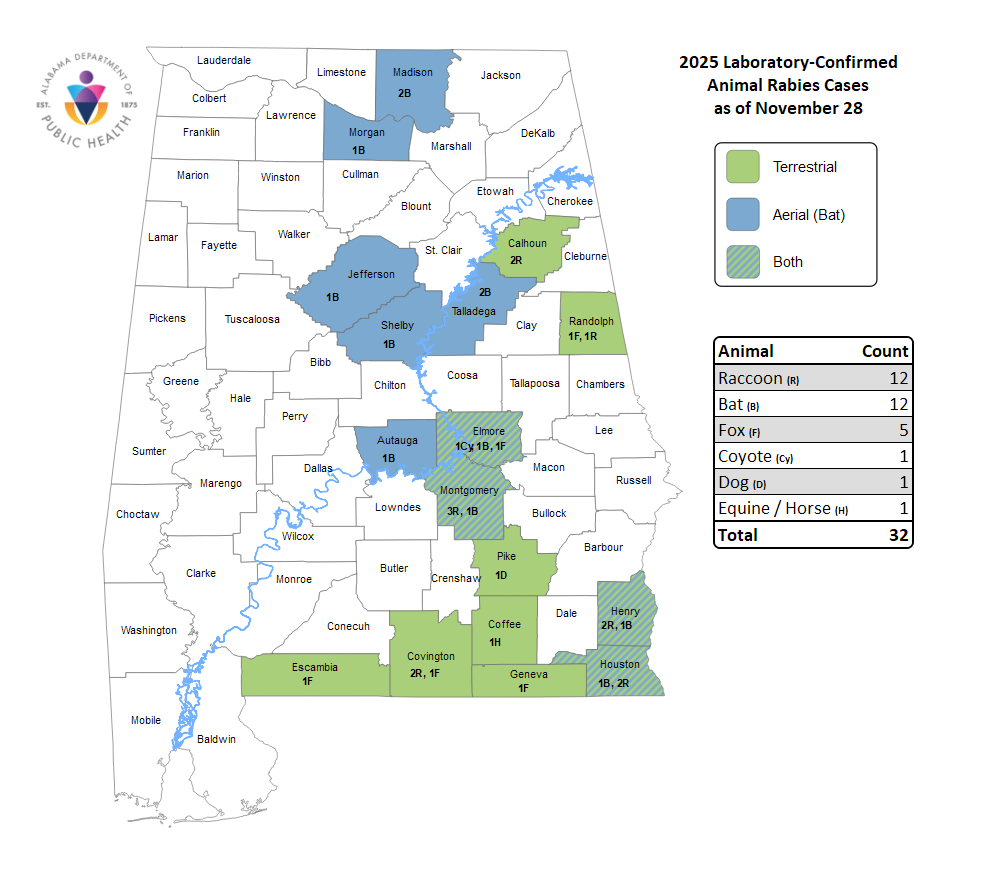
Every Alabama dog must be vaccinated against rabies once it reaches three months of age, under section 3-7A-2, and the owner receives a certificate. Ask for it. Rabies is still present in the state: the department’s map of 2025 laboratory-confirmed cases lists 35 animals, mostly raccoons and bats, including one dog in Pike County. If the dog that bit you was not vaccinated, read about being bitten by an unvaccinated dog.
An average would tell you little about your own claim. The most useful published figure is national insurance data. The Insurance Information Institute and State Farm put the average cost of a dog related injury claim in 2025 at $65,450, across 28,450 claims nationwide, in their 2025 report. That report gives no Alabama figure. It is an industry average across every claim, large and small, and it does not predict any Alabama case.
What actually moves the number in Alabama:
The dog bite settlement calculator gives a rough sense of ranges.
The money in a dog bite claim often comes from the dog owner’s homeowners or renters policy. The Insurance Information Institute says standard homeowners and renters policies typically cover dog bite liability up to the policy’s liability limits, usually $100,000 to $300,000, with the owner responsible for anything above that.
Two Alabama points:
Do not take the owner’s word that there is no insurance. Ask in writing for the carrier and policy number.
For the full process, read our guide on how to file a dog bite claim, and keep every record of medical evidence in a dog bite claim.
Dog Bite Laws handles dog attack cases, and in Alabama the details decide the outcome. Where you were bitten determines which claim you have, what the owner knew determines what it is worth, and under contributory negligence a careless answer to an adjuster can end a good case.
We find the owner and every keeper, landlord, and policy connected to the dog. We request the health department’s quarantine record, the animal control file, and any Emily’s Law proceedings, look for earlier complaints that prove knowledge, and file the six month notice when a city or town may be responsible. We deal with the insurer so that you do not have to.
We work on a contingency fee, so there is nothing to pay up front and no fee unless we recover money for you. Founding attorney Michael Agruss built the firm around injured people who need someone else to carry the paperwork. We take dog bite cases across Alabama, including Birmingham, Montgomery, Huntsville, Mobile, and Tuscaloosa. If you or your child was bitten, contact us for a free consultation, and we will tell you honestly whether there is a claim worth bringing.
Only partly. Section 3-6-1 makes the owner liable without proof of an earlier bite when the dog bites or injures someone lawfully on the owner's property, or chases them off it, and the dog was not provoked. Anywhere else, you must prove the owner or keeper knew or had reason to know the dog was dangerous. Even on the owner's property, an owner who proves he knew nothing can limit the statutory claim to actual expenses.
Possibly, but it is harder. The dog bite statute does not apply off the owner's property unless the dog chased you from it. You would bring a common law claim and show the owner knew, or had reason to know, of the dog's dangerous tendencies. Earlier bites, attacks on people, and complaints to the owner or animal control are the kind of proof that works. Alabama also charges owners and keepers with knowledge of the propensities of their dog's breed, but you still need evidence of what those propensities are.
Yes, on a negligence claim. Alabama keeps the contributory negligence rule, so a victim whose own negligence helped cause the injury can be barred completely. The dog owner must prove it, and it does not defeat a claim that the owner acted wantonly. A child between 7 and 14 is presumed incapable of contributory negligence, though that presumption can be rebutted. Be careful what you tell an insurance adjuster before you speak with a lawyer.
Generally two years from the bite for an adult. A child has until two years after turning 19, so usually the twenty first birthday. If a city or town may be responsible, the claim must be presented within six months with a sworn statement filed with the clerk, and a county claim must be presented within 12 months. A wrongful death claim must be filed within two years of the death.
Often, but it depends on the facts. Alabama's statute treats people as lawfully on the owner's property when performing a duty imposed by law, including postal duties, reading meters, delivering milk, repairing utilities, or when there on the owner's or tenant's express or implied invitation. Package delivery is not named, so the answer may turn on that invitation clause. Two of the Supreme Court of Alabama's leading dog cases involved delivery workers, one knocked down by a pit bull and one hurt running from a dog that charged out of a front door.
Sometimes. The Supreme Court of Alabama has held that a landlord must use reasonable care to protect tenants and guests from a tenant's vicious dog in areas shared by tenants, such as a courtyard. The key is notice: you must show management knew or should have known the dog was dangerous, and a prior complaint to the manager is strong evidence. That 1994 decision did not decide whether a landlord can be liable for a bite inside the tenant's own unit.
It must be quarantined for 10 days under a veterinarian's supervision, sometimes at the owner's home if it is vaccinated, and the owner cannot give it away or move it until released. Separately, anyone can start a dangerous dog case under Emily's Law with a sworn statement. A court must order euthanasia if the dog caused serious physical injury or death, and the owner may face criminal charges.
"*" indicates required fields
Mike Agruss Law was extremely easy to work with. They helped me on two different times. Communication was top notch. If ever in need I would use again and have recommended to several people.
Mike Agruss is an extremely knowledgeable personal injury attorney who puts his client’s best interests first. Whenever I reach out to him with questions, he always gets back to me right away, which is extremely refreshing when dealing with an attorney. I highly recommend him and his firm!
Mike Agruss Law was incredibly helpful and tenacious at fighting for me with my case. I am beyond satisfied with my results and cannot recommend them enough for all the hard work they put in. They really care about what they do and care about their clients and it can be seen in the work they do. All that is left to say was that my case was a win-win all around very happy with the results. Please consider them if you have any issues.
This was the easiest and best experience I’ve experienced with a law firm. They represented me aggressively and handled my case with finesse and diligence. I highly recommend anyone who is having any issues to reach out to Mike Agruss Law Firm. They WILL take care of you.
Mike called me on the weekend to answer a question I had emailed him on a Friday I wasn’t expecting to hear from him until Monday. He went above and beyond anything I could have ever expected. Not only is he a excellent attorney he is also a kind, caring and a patient person. I was truly blessed by him, his paralegal, and this law firm.
"*" indicates required fields
Contact us via call, email, text, or chat to discuss your case.