

Key Takeaways
- There are six dog bite levels, defined by Dr. Ian Dunbar’s Dog Bite Scale. They run from Level 1 (threatening behavior, no contact) to Level 6 (the victim dies).
- The scale measures the dog, not your injury. Its own subtitle calls it an assessment of “biting problems,” and every note in it is about whether the dog can be rehabilitated.
- Levels 3 and up are the ones that break skin. Dunbar puts Levels 1 and 2 at well over 99% of all dog incidents, so a bite that punctures is already the rare, severe end of the scale.
- The dividing line between Level 3 and Level 4 is puncture depth, measured against half the length of the dog’s canine teeth. Level 4 also brings deep bruising or side-to-side tearing.
- No state decides your claim by Dunbar level. Illinois, for example, classifies dogs by whether the bite caused “serious physical injury,” a defined term that includes disfigurement and plastic surgery.
- Bite location and permanence drive value far more than the level does. A Level 3 bite to a child’s face is usually worth more than a Level 4 to an adult’s calf.
Dog bite levels come from the Dunbar Bite Scale, a six-level system that ranks a bite by how much damage the dog’s teeth actually did, from Level 1 (no skin contact at all) to Level 6 (the victim dies). It was created by veterinarian and animal behaviorist Dr. Ian Dunbar, and it is the scale your veterinarian, an animal control officer, or a behavior consultant is using when they say “that was a level 3.”
Here is the part almost nobody explains, and it matters if you were the one bitten: the scale was built to assess the dog. It tells a trainer how much bite inhibition a dog has and how likely it is to be rehabilitated. It was never designed to measure your injury, and no state bases liability on it. Below is what each level actually means, in the official wording, and then what really determines what your case is worth.
The 6 dog bite levels at a glance
These are the definitions from Dr. Ian Dunbar’s Dog Bite Scale (Official Authorized Version), published by the Association of Professional Dog Trainers.
| Level | What defines it | Skin broken? |
|---|---|---|
| Level 1 | Obnoxious or aggressive behavior, but no skin contact by teeth | No |
| Level 2 | Skin contact by teeth, but no puncture. May leave nicks less than one tenth of an inch deep and slight bleeding from sideways movement of the teeth | No punctures |
| Level 3 | One to four punctures from a single bite, none deeper than half the length of the dog’s canine teeth | Yes |
| Level 4 | One to four punctures from a single bite, with at least one deeper than half the canine tooth length. Often deep bruising, or tearing in both directions from head shaking | Yes, deeply |
| Level 5 | Multiple bites with at least two Level 4 bites, or a multiple-attack incident with at least one Level 4 bite in each | Yes, repeatedly |
| Level 6 | The victim dies | Fatal |
One clarification worth having, because it causes real confusion. You may find versions of this scale that split Level 3 into 3A and 3B, or that word Level 1 differently. Those are modified adaptations, including an illustrated version circulated through Veterinary Partner and a version adapted with Calgary Animal Services. The six-level wording in the table above is the official authorized version.
What the Dunbar scale actually measures
The scale grades the dog’s bite inhibition, not the seriousness of your injury. The official document’s own subtitle describes it as “an assessment of the severity of biting problems based on an objective evaluation of wound pathology.” Read the notes Dunbar attaches to each level and the purpose is unmistakable: they are about prognosis for the dog.
At Levels 1 and 2, Dunbar’s note says the dog is “certainly not dangerous” and the prognosis is “wonderful,” resolvable with basic training. At Level 3 the prognosis is “fair to good” with owner compliance. At Level 4 he writes that the dog “has insufficient bite inhibition and is very dangerous,” with a poor prognosis. At Levels 5 and 6 he recommends euthanasia.
Every one of those judgments is about the animal’s future. None of them is about your medical bills, your scarring, your lost work, or your ability to use your hand again. That is why a level, on its own, tells an insurance adjuster very little and should not tell you very much either.
How rare is a bite that actually breaks skin?
Rarer than most people assume. Dunbar’s own estimate is that Levels 1 and 2 together account for well over 99% of dog incidents. Because those two levels are precisely the ones that leave no puncture wound, it follows that fewer than one incident in a hundred involves a bite that punctures skin at all.
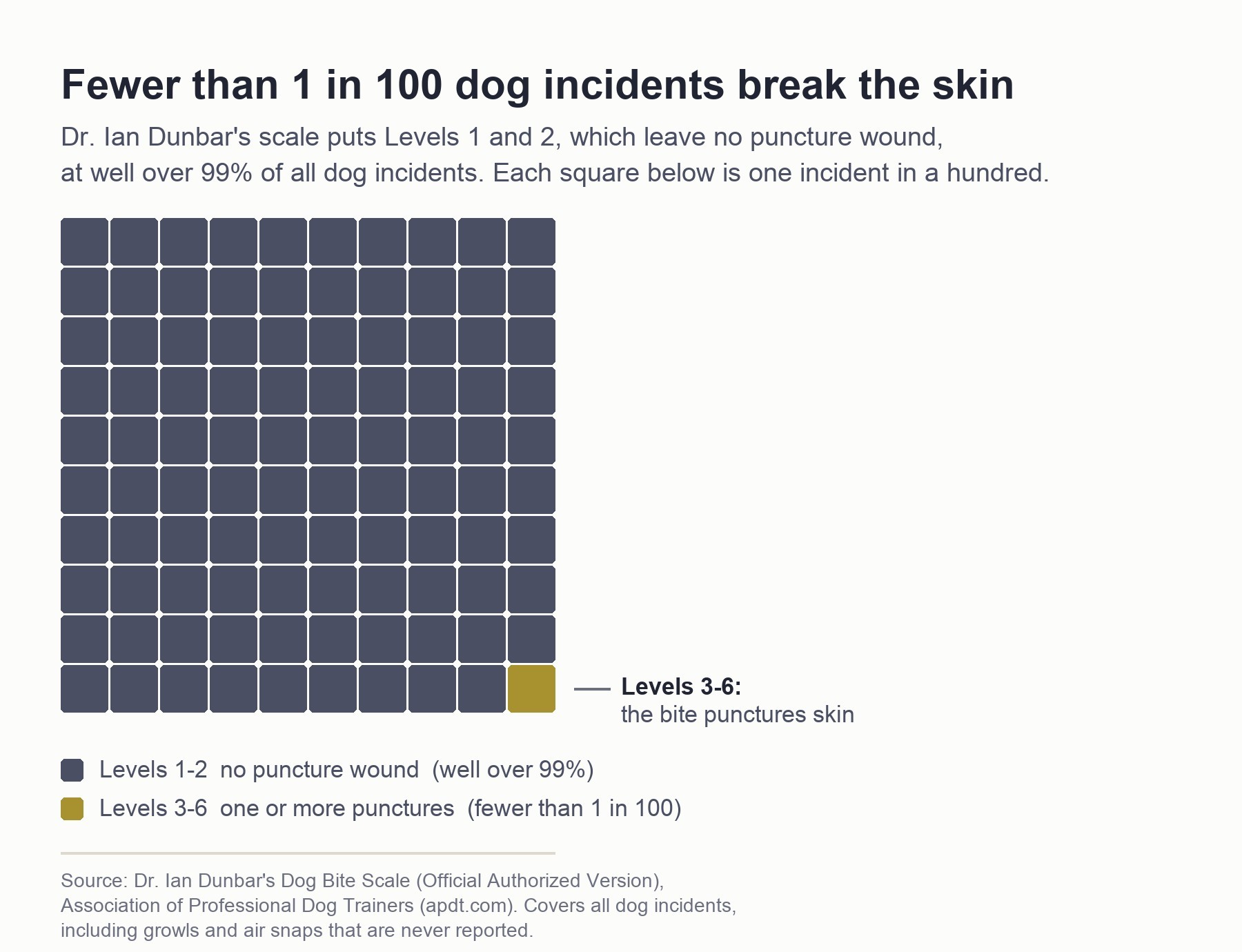
Read that carefully, because the scope matters and it is easy to misuse. Dunbar is describing all dog incidents, which includes every growl, lunge and air snap that never gets reported to a doctor, an insurer or animal control. It is not a share of emergency room visits, and it is not a share of reported bites. Among bites serious enough that someone seeks treatment, the mix naturally skews far more severe.
The useful takeaway is about where you sit. If a dog put holes in your skin, you are not in the ordinary run of dog incidents. You are in the fraction that the person who built this scale considered genuinely dangerous behavior.
Level by level, in plain English
Level 1: aggressive behavior, no contact
Growling, lunging, snapping at air. The teeth never touch skin. People often describe this as “he tried to bite me,” and on the scale it is still Level 1 because contact never happened. There is no wound to treat.

Level 2: teeth touch, skin stays closed
The dog’s teeth make contact but do not puncture. There may be redness, bruising, a scrape, or a nick less than a tenth of an inch deep from the teeth dragging sideways. It is worth knowing that a Level 2 is not automatically harmless: people are knocked down and break wrists, elbows and hips in incidents where the dog never punctured skin at all.
Level 3: punctures, shallower than half a canine tooth
One to four punctures from a single bite, with no puncture deeper than half the length of the dog’s canine teeth. There may be tearing in a single direction, usually because the victim pulled their hand back or the owner pulled the dog away. This is the level at which a bite becomes a puncture wound, and puncture wounds are the ones that carry the highest infection risk because they seal over and trap bacteria underneath.
Level 4: at least one deep puncture
Same one to four punctures from a single bite, but at least one goes deeper than half the canine tooth length. Dunbar’s definition also flags two other signs: deep bruising around the wound, which means the dog held on and bore down, and tearing in both directions, which means the dog held on and shook its head side to side. Level 4 is where crush injury, tendon damage and nerve damage start to appear alongside the punctures.
Level 5: multiple deep bites
A multiple-bite incident with at least two Level 4 bites, or a multiple-attack incident with at least one Level 4 bite in each attack. In practice this is a sustained attack rather than a single snap, and it is the category most associated with hospital admission, surgery and permanent scarring.
Level 6: the victim dies
Dunbar’s scale ends with a fatality. These cases are rare, and they are handled as wrongful death claims rather than ordinary injury claims.
Bitten badly enough to be reading this? Talk to us before you talk to the insurer
If you are here because a doctor or an animal control officer used the words “level 3” or “level 4,” you have a puncture wound, and you are in the small fraction of dog incidents that cause real injury. That is exactly when an insurance adjuster tends to call early, sound sympathetic, and offer a number before anyone knows whether the wound will get infected, whether the tendon is damaged, or how the scar will settle.
Once you accept, that is the end of it, even if the wound turns septic a week later. A conversation with us costs nothing and carries no obligation, and we work on contingency: No Fees Unless Until We Win. Call 312-786-4442 any time, day or night, or use our contact form.
Why your bite level does not set your case value
No state dog bite statute assigns liability or damages by Dunbar level. The scale has no legal status. States that classify dogs at all use their own statutory definitions, and those definitions turn on different facts entirely.
Illinois is a clear example. Under the Illinois Animal Control Act, 510 ILCS 5/2.05a defines a “dangerous dog” to include a dog that, without justification, bites a person and does not cause serious physical injury. A “vicious dog” under 510 ILCS 5/2.19b is one that attacks without justification and causes serious physical injury or death, or that has been found dangerous on three separate occasions. And “serious physical injury” is itself defined at 510 ILCS 5/2.19a as an injury creating a substantial risk of death, or causing death, serious disfigurement, protracted impairment of health, impairment of a bodily organ, or plastic surgery.
Notice what those definitions actually hinge on: whether the bite was justified, how serious the injury was, and whether it happened before. Dunbar levels appear nowhere. A Level 3 bite to a child’s face that needs plastic surgery meets the Illinois definition of serious physical injury. A Level 4 puncture to an adult’s calf that heals cleanly may not. The level ranked those two the other way around.
What actually moves the value of a dog bite claim is a different list:
- Where the bite is. Face, head, neck and hands are worth substantially more than covered areas, because the scarring is visible and hand injuries affect the ability to work.
- Whether it scars permanently. A scar keeps changing for months, and the settlement does not. See our guide to dog bite scars and what they are worth.
- Whether it gets infected. Puncture wounds seal bacteria in, and an infection can turn a modest claim into a serious one. See dog bite infection signs and treatment.
- The age of the victim. Children are bitten on the face far more often, and child claims are handled differently.
- Lasting function. Nerve damage, tendon damage and reduced grip strength carry far more weight than the puncture count.
- The state’s liability rule. Most states impose strict liability on the owner; a minority still apply a one bite rule. Which one governs matters more than any level.
If you want figures rather than principles, we keep them by severity: level 3 dog bite settlements, level 4 dog bite settlements, and level 5 dog bite settlements, all under our dog bite settlement amounts hub.
What to do now, whatever level you were told
- Get the wound treated and get the level written down. Ask the treating clinician to record the number of punctures, the depth, and the location in your chart. That record, not the label, is what carries weight later.
- Photograph the injury today and keep photographing it. Punctures look minor on day one and dramatic on day four. Photograph weekly as it heals.
- Report the bite to animal control. This creates the official record, and in states with dangerous dog statutes it is what triggers any classification of the dog.
- Get the owner’s name, address and insurer. Most claims are paid by a homeowners or renters policy rather than by the owner personally. See whether insurance covers dog bites.
- Watch for infection and go back if you see it. Spreading redness, heat, swelling, pus or fever after a puncture wound needs same-day care.
- Talk to a dog bite lawyer before you talk to the insurer, and before you sign anything. The adjuster’s first offer usually lands before anyone knows whether the wound will get infected or how the scar will mature, and accepting it closes the claim permanently. Call 312-786-4442 for a free, no obligation review, or reach us through our contact form. We work on contingency, so there is no cost to find out where you stand.
- Mind the filing deadline. Every state limits how long you have. Check the dog bite statute of limitations in your state.
For the wider picture of what follows a bite, including what happens to the dog and to the owner, see what happens when a dog bites someone and our step by step guide to filing a dog bite claim. You can also learn more about how we handle dog bite cases.
Frequently Asked Questions
What is the Dunbar bite scale?
The Dunbar bite scale is a six-level system for classifying dog bites by how much damage the dog’s teeth caused, created by veterinarian and animal behaviorist Dr. Ian Dunbar. Level 1 is aggressive behavior with no skin contact, Level 2 is contact without puncture, Levels 3 and 4 are single bites with shallow and deep punctures, Level 5 is multiple deep bites, and Level 6 is a fatality. It was designed to assess a dog’s bite inhibition and rehabilitation prospects, not to measure a victim’s injury, and it has no legal standing in any state.
What level of dog bite is serious?
Level 3 and above are the levels that break skin, and Level 4 and above are the ones Dunbar himself describes as very dangerous. A Level 3 bite produces one to four punctures, none deeper than half a canine tooth. Level 4 means at least one deeper puncture, often with crushing or tearing. That said, seriousness for medical and legal purposes depends far more on where the bite is and what it leaves behind. A Level 2 that knocks an elderly person down and breaks a hip, or a Level 3 to the face that scars, can be more serious in every way that matters than a deeper bite somewhere hidden.
Can I sue for a level 3 dog bite?
Yes. A Level 3 bite breaks skin and causes real injury, and nothing about the level itself prevents a claim. Whether you recover depends on your state’s rule rather than the number. Most states impose strict liability, meaning the owner is responsible even if the dog never bit anyone before; a minority still apply a one bite rule requiring some knowledge of the dog’s tendencies. Because a Level 3 leaves puncture wounds, these claims often grow after the fact when infection or scarring develops, which is why it is worth speaking to a lawyer before accepting any early offer. Call 312-786-4442 for a free review.
How is a level 3 dog bite treated?
A Level 3 bite needs professional medical care, because puncture wounds carry a high infection risk even when they look small. Treatment typically involves thorough irrigation and cleaning of the wound, an assessment of tetanus and rabies risk, and often preventive antibiotics. Puncture wounds are frequently left open rather than stitched, since closing them can seal bacteria inside. Follow the treating clinician’s guidance, and go back immediately if you develop spreading redness, swelling, warmth, pus or fever. Our guide to dog bite infection covers the warning signs in detail.
What is a level 5 dog bite?
A Level 5 dog bite is a multiple-bite incident containing at least two Level 4 bites, or a multiple-attack incident with at least one Level 4 bite in each attack. In plain terms, the dog bit deeply more than once rather than snapping a single time. These are sustained attacks, and they are the incidents most likely to involve hospital admission, surgery, permanent scarring and lasting nerve or tendon damage. Dunbar classifies dogs at this level as extremely dangerous. Claims arising from Level 5 attacks are usually the highest value dog bite claims short of a fatality.
Bitten by a Dog? We Can Help.
A puncture wound that seems minor today can become an infection, a permanent scar, or a hand that never works quite the same, and the insurer’s first offer almost always arrives before any of that is known. If you or a loved one was bitten or attacked by a dog, Dog Bite Laws, the dog bite injury team at Mike Agruss Law, offers free, no obligation consultations to review your case. We work on contingency: No Fees Unless Until We Win. Call us at 312-786-4442 or reach out through our contact form to discuss your rights and options.
This information is provided for educational purposes and does not constitute legal advice. Dog-bite laws vary by state, and every case is unique. Results depend on the specific facts and circumstances.

