

Key Takeaways
- A bite that did not break the skin is still a bite. The dog’s jaws compress the tissue underneath, which can leave deep bruising, a hard lump of pooled blood, or nerve and muscle damage that the unbroken skin hides.
- The medical news is mostly good. Seattle Children’s Hospital says bites that do not break the skin cannot become infected, and the CDC’s rabies guidance says saliva on intact skin is not a rabies exposure.
- In Illinois and Wisconsin, the owner can be liable whether or not the skin was broken. Illinois covers any dog that “attacks, attempts to attack, or injures” you, and Wisconsin makes the owner liable for the full amount of damages from any injury the dog causes.
- Wisconsin’s statute does use the phrase “break the skin,” but only to decide when damages are doubled for a repeat biter, not whether you can recover at all.
- The most common mistake is not reporting it. An unreported bite leaves no record for your own claim and no warning on file for the next person the dog bites.
- If the owner’s insurer calls and says there is “no injury” because there was no puncture, talk to a lawyer before you answer. Free, 24/7, no fee unless we win.
If a dog bit you but did not break the skin, you have still been bitten, and you can still have a real injury and a legal claim. The skin is only the top layer. A dog’s jaws clamp and squeeze, and that pressure lands on the muscle, blood vessels and nerves underneath whether or not a tooth goes through. That is why a bite with no blood can leave a bruise the size of a palm, a lump that lasts for weeks, or a hand that goes numb.
The honest picture has two halves. Medically, an unbroken-skin bite is usually the least dangerous kind: the infection and rabies risks that make other bites urgent mostly do not apply. Legally, it counts. Most people who search this question are trying to decide whether it is “bad enough” to report, to see a doctor, or to mention to the owner’s insurer, and the answer to all three is the same: yes, and today.
This guide covers what a no-puncture bite actually does to the body, what the infection and rabies guidance really says, when it needs a doctor, and how the law in several states treats a bite that never drew blood.
What a Bite That Didn’t Break the Skin Actually Does
A dog bite is a crushing injury as much as a cutting one. Cleveland Clinic describes the mechanics plainly: a dog’s front teeth grab and compress your tissue, while the smaller teeth tear the skin. When the skin holds, the tearing part does not happen. The compressing part still does.
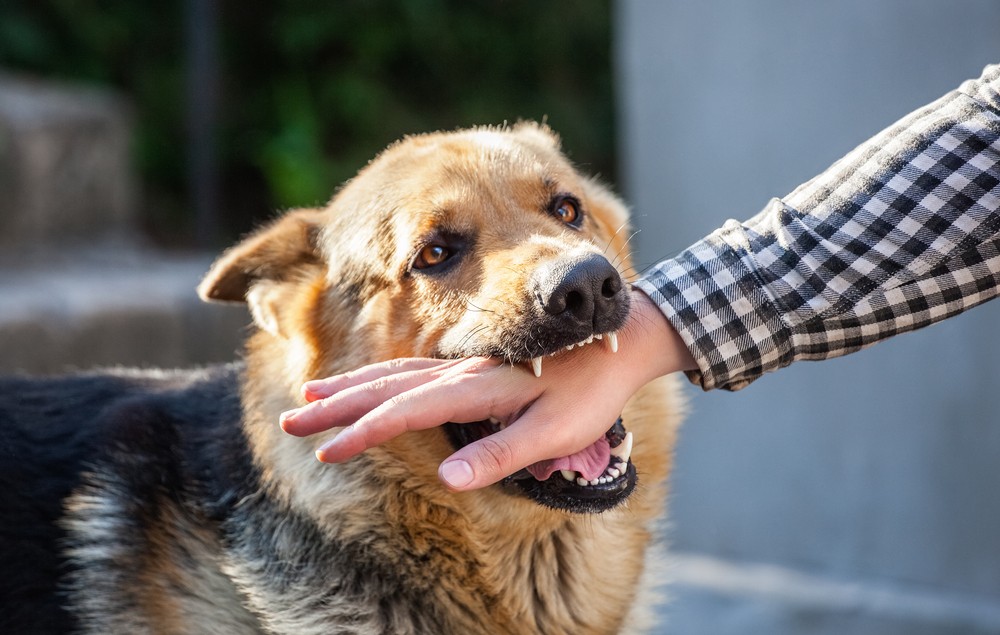
What that pressure can leave behind:
- Deep bruising. Bleeding under the skin from crushed blood vessels. It often looks worse on day two or three than it did in the first hour.
- A hematoma. A firm, sometimes painful lump where blood has pooled under the skin after a hard clamp.
- Swelling. Especially in the hand and fingers, where there is little room for it. Seattle Children’s lists finger or hand swelling after an animal bite as a reason to call a doctor or seek care now.
- Nerve and soft tissue injury. Numbness, tingling or weakness after a bite means something under the skin was affected, however clean the surface looks.
Clothing makes all of this more likely. A bite through a coat sleeve or jeans often leaves the skin intact precisely because the fabric took the teeth, while the jaw pressure went straight through. We explain that mechanism in detail in our guide to a dog bite on the leg. And if the dog knocked you over, jumped on you or chased you into a fall without its teeth ever touching you, that is a different situation with its own rules, covered in our guide to a dog attack without a bite.
Trainers and behaviorists have a name for this kind of bite. On the Dunbar bite scale it is a Level 2: teeth made contact with the skin but did not puncture it. Our guide to dog bite levels explains the full scale, and why it grades the dog rather than your injury.
Infection and Rabies: What the Guidance Actually Says
This is the reassuring part: when the skin is genuinely unbroken, the two risks that make dog bites urgent largely fall away.
Infection
Seattle Children’s Hospital’s bite guidance puts it directly: bites that don’t break the skin can’t become infected. Its wound categories list a bruise, meaning no break in the skin, as carrying no risk of infection, and it places a bite that “did not break the skin or is only a bruise” in its self-care-at-home group. That guidance is written for parents of children, but the reasoning behind it is simple: bacteria from the dog’s mouth need a way in.
The catch is the word “genuinely.” A scrape, a tiny nick or a split at the edge of a bruise is a break in the skin, even if it barely bled. If there is any opening at all, the rules for an ordinary bite apply, and our guide to dog bite infection covers the warning signs and timeline.
Rabies
The CDC’s rabies recommendations, published by its Advisory Committee on Immunization Practices, define a bite exposure as any penetration of the skin by teeth. The same document says contact of saliva with intact skin does not constitute an exposure, and that post-exposure shots should not be given in that situation. The CDC’s current clinical guidance says rabies can spread through direct contact between broken skin or mucous membranes and infectious saliva.
Two caveats are worth knowing. Saliva in the eyes, nose or mouth is a possible exposure even with no bite, because those are mucous membranes. And the decision about rabies shots belongs to a clinician or your local health department, not to a search result. If the dog was a stray, its vaccination status is unknown, or it was acting strangely, get that assessment. Our guide to being bitten by an unvaccinated dog explains how that process works.
When a Bite Without Broken Skin Still Needs a Doctor
Most unbroken-skin bites heal on their own, but several situations still call for a medical visit, and there is a second reason to go that has nothing to do with medicine.
Get it checked if any of these apply:
- The pain is out of proportion to what you can see, or it is getting worse rather than better.
- Swelling keeps increasing after the first day, especially in a hand or finger.
- You have numbness, tingling, weakness, or trouble moving a finger, wrist or joint.
- A hard lump forms and does not start to shrink.
- The bite was on the face, or near the eyes or mouth.
- The person bitten is a young child, who may not be able to describe what hurts.
- You are not sure whether the skin is broken at all.
The second reason is the record. A same-day or next-day visit creates a dated, independent note of the bruising, the swelling and what you reported feeling. Bruises fade in a week or two. If the owner’s insurer later questions whether you were hurt at all, that note and your photographs are what answer them. Our guide to medical evidence in a dog bite claim explains why an early record carries so much weight.
Does It Count as a Dog Bite in the Eyes of the Law?
Yes. In Illinois and Wisconsin the owner can be liable whether or not the skin was broken, and nothing in the text of California’s dog bite statute requires broken skin. Dog bite law is set state by state, and the exact wording of each statute matters, so here is how those three states and the one-bite states treat it.
States where any injury counts
Illinois does not require a bite at all. The Animal Control Act at 510 ILCS 5/16 makes the owner liable where a dog, without provocation, “attacks, attempts to attack, or injures any person who is peaceably conducting himself or herself in any place where he or she may lawfully be.” A bite that bruised you without breaking the skin is squarely an attack and an injury. See our Illinois dog bite page.
Wisconsin is the most interesting statute on this exact question, because it actually uses the phrase. Wis. Stat. § 174.02(1)(a) makes the owner of a dog “liable for the full amount of damages caused by the dog injuring or causing injury to a person.” No bite, and no broken skin, is required. The words “break the skin” appear only in the next paragraph, which doubles the damages when the dog bit “with sufficient force to break the skin and cause permanent physical scarring or disfigurement” and the owner already knew it had bitten someone that way before. In other words, Wisconsin uses broken skin to decide when the owner pays twice, not whether the owner pays at all. Our Wisconsin dog bite page covers the double damages rule.
States whose statute says “bitten”
California’s strict liability statute is written around a bite. Civil Code section 3342 makes the owner liable for damages suffered by any person “who is bitten by the dog while in a public place or lawfully in a private place,” regardless of the dog’s history or the owner’s knowledge. The statute does not define “bitten,” and nothing in its text requires the skin to be broken. Where a bite genuinely did not happen, a California claim has to be built on negligence instead. See our California dog bite page.
One-bite states
Some states, including Texas, have no general dog bite statute and apply the common law one-bite rule. There, the question is usually whether the owner knew or should have known the dog was dangerous, or whether the owner was negligent, for example by breaking a leash law. A bite that did not break the skin matters here in two directions. It can still be the basis of your own negligence claim. And an earlier bite of that kind, if it was reported, is the sort of history that can show a future victim the owner had been warned. Our one-bite law explainer shows which states follow which rule.
Why “It Didn’t Break the Skin” Costs People Their Claims
The phrase does more damage to people’s claims than the bite itself usually does. Here is how it tends to play out.
- Nobody reports it. The victim decides it was not serious enough, so there is no animal control record, and the owner is not formally warned. Our guides to what happens after a dog bite is reported and what happens if you don’t report a dog bite explain what that record does for you.
- Nobody sees a doctor. So when the bruise turns into a hematoma, or the numbness in two fingers does not go away, there is no note from day one tying it to the bite.
- The owner is someone you know. Unbroken-skin bites very often come from a neighbor’s or relative’s dog, and people do not want to make trouble. What most people do not realize is that the claim is usually paid by the owner’s homeowners or renters insurance, not out of their friend’s pocket. Our guide to whether insurance covers dog bites explains how that works.
- The insurer uses the phrase against you. “There was no puncture” becomes “there was no injury,” and anything you said to play it down is repeated back to you.
To be straight with you: a bruise that fades in ten days with no other effects is usually a small claim. But a bite that leaves nerve symptoms, a lasting lump, a fall, or a frightened child is not small just because the skin held. Fear after an attack is real and recognized, and our guide to emotional trauma after a dog attack covers it.
If the owner’s insurance company has already called and suggested there is nothing to claim because the skin wasn’t broken, talk to a lawyer before you talk to them again. That argument works best in the first few days, before the bruising, swelling or numbness has shown what the bite actually did. Our dog bite attorneys will tell you for free whether you have a claim worth pursuing, and there is no obligation and no fee unless we win. Call 312-786-4442 any time, day or night, or use our contact form.
What to Do After a Dog Bite That Didn’t Break the Skin
In order, and none of these depend on how minor it looks right now:
- Check the skin properly. Look closely, in good light, for any scrape, nick or split. If there is any break at all, treat it as an ordinary bite and get it seen.
- Wash the area and cool it. Seattle Children’s advises washing all bite wounds with soap and water for five minutes, and for pain or bruising, a cold pack or ice wrapped in a wet cloth applied to the bruise once for 20 minutes.
- Photograph it today and every day for a week. Bruising changes color and spreads, and the day-three photo is often the most convincing one. Photograph any torn or marked clothing too.
- See a doctor if any warning sign above applies, or if you simply are not sure. Tell them the dog clamped down, so they check what is under the skin.
- Report the bite to animal control. An unbroken-skin bite is still a bite, and the report protects both you and the next person.
- Get the owner’s name, address and insurance details, and contact details for anyone who saw it happen.
- Talk to a lawyer before you talk to the insurer. The adjuster’s first call usually comes while the bruise still looks minor, and “it didn’t even break the skin” is the sentence they hope you will say. A free consultation costs you nothing and happens before you have given anything away.
- Do not sign anything while symptoms are still changing. Our guide to the dog bite statute of limitations explains how long you actually have, which in some states is only one year.
If you want a sense of how injuries are valued, our guide to dog bite compensation covers the categories of damages, and dog bite settlement amounts explains what moves the number up or down.
Frequently Asked Questions
Does it count as a dog bite if it didn’t break skin?
Yes. A bite where the dog’s teeth closed on you counts as a dog bite even if the skin was not broken. In Illinois and Wisconsin, the owner can be liable whether or not the skin was broken. Illinois covers any dog that attacks, attempts to attack or injures a person, and Wisconsin makes the owner liable for any injury the dog causes, using broken skin only to decide when damages are doubled for a repeat biter. California’s statute uses the word “bitten” without defining it. Medically, a bite without broken skin carries far less infection and rabies risk, which is a separate question from whether it counts.
What happens if a dog bites you but doesn’t break skin?
If a dog bites you without breaking the skin, the usual result is bruising and soreness from the pressure of the jaws, and in most cases it heals on its own. The jaws compress the muscle, blood vessels and nerves under the skin, so you can still get deep bruising, a hard lump of pooled blood, swelling, or numbness. Wash the area, cool it, photograph it for several days, and see a doctor if pain or swelling worsens, if you have numbness or trouble moving, or if the bite was on the face or on a young child. Report the bite to animal control either way.
Can I get rabies if the dog didn’t break skin?
A bite that did not break the skin is not treated as a rabies exposure under the CDC’s rabies recommendations. The CDC’s Advisory Committee on Immunization Practices defines a bite exposure as any penetration of the skin by teeth, and says contact of saliva with intact skin does not constitute an exposure. The exceptions are saliva getting into the eyes, nose or mouth, and any small break in the skin you may have missed. If the dog was a stray, unvaccinated, or behaving strangely, ask a clinician or your local health department to assess you rather than deciding on your own.
Can a bite get infected if it didn’t break skin?
A bite that genuinely did not break the skin cannot become infected, because bacteria from the dog’s mouth have no way in. Seattle Children’s Hospital’s bite guidance lists a bruise with no break in the skin as carrying no risk of infection. The important word is genuinely: a scrape, a small nick or a split at the edge of a bruise is a break in the skin, even if it barely bled. If there is any opening, watch for spreading redness, warmth, pus or fever, and see a doctor if they appear.
How to treat a dog bite that hasn’t broken the skin?
To treat a dog bite that hasn’t broken the skin, wash it with soap and water, apply a cold pack wrapped in a cloth to the bruise, and watch it over the next few days. Seattle Children’s advises washing all bite wounds for five minutes and applying a cold pack to a bruise once for 20 minutes to help with pain and swelling. Check closely for any scrape or nick, since that changes the advice. See a doctor if the pain or swelling gets worse, if you have numbness or trouble moving, or if the bite was on the face or a young child. Photograph the bruise each day, and report the bite to animal control.
Bitten but the Skin Wasn’t Broken? We Can Help.
An unreported, undocumented bite is the easiest kind for an insurer to deny, and the bruise that proves it will be gone within a couple of weeks. If you or a loved one was bitten by a dog, even if the skin was not broken, Dog Bite Laws, the dog bite injury team at Mike Agruss Law, offers free, no-obligation consultations to review your case. We work on contingency: No Fees Unless Until We Win. Call us at 312-786-4442, available 24/7, or reach out through our contact form to discuss your rights and options. You can also read more about how we handle these cases on our dog bite page.
This information is provided for educational purposes and does not constitute legal advice. Dog-bite laws vary by state, and every case is unique. Results depend on the specific facts and circumstances. It is also not medical advice; if you have been bitten, seek care from a qualified clinician.


